•  

The People of Okunoto

The people of Okunoto. Farmers build thousand paddy fields. Fishermen, who do not have a fishing port, make salt in pumping salt fields. There are also migrant workers and peddlers.   The people of Okunoto, despite the rough seas of the Sea of Japan and the poverty of their half-farming, half-fishing existence, build Senmaida rice paddies (paddies built on sloping land), people make salt the old-fashioned way, the last of the Agehama salt paddies where salt is pumped with labor, the cutting down of Asunaro forests, a tribe of fishermen turned plasterers, women peddling fish, and women peddling fish and vegetables at the morning market in Iida. Women peddling fish, women peddling fish and vegetables at the morning market in Iida, a general merchandise market held in each village  before winter preparations, and women leaving for Kansai in search of work before winter. The film was shot on an unknown date, and was released on November 4, 1960.

  •  
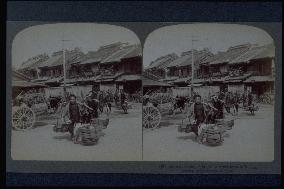
A cargo carrier

A cargo carrier

Three thousand ryo a day falls where it must. This senryu poem means that everyday people spend three thousand ryo (monetary unit in the Edo Period), one thousand in the fish market in the morning, one thousand in the theatres during the daytime, and one thousand in the Yoshiwara pleasure quarter in the evening. There was a fish market on the east side of the northern edge of Nihonbashi Bridge during the Edo Period. The man in this photograph is selling fish he just bought at the fish market. Probably taken near Nihonbashi. Since there was no refrigeration then, fish had to be sold within a day and people ate fresher fish than today. This stereograph is dated 1904.==Date:1904, Place:Tokyo, Photo:Underwood, (Credit:Nagasaki University Library/Kyodo News Images) [Cabinet Number97‐77‐0]

  •  
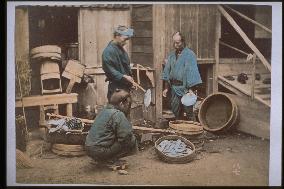
A fish seller

A fish seller

The fish peddler walked around the city carrying fish in a shallow tub that hung from a carrying pole on his shoulder. The man on the right holding a plate is a customer. He would use the plate to carry the purchased fish home. Called furiuri, these peddlers played an indispensable role in daily life.==Date:1868, Place:unknown, Photo:unknown, (Credit:Nagasaki University Library/Kyodo News Images) [Cabinet Number64‐71‐0]

  • Main
  • Top
  • Editorial
  • Creative
  • About Us
  • About ILG
  • Terms of use
  • Company
  • BEHIND
  • Price List
  • Single Plan
  • Monthly Plan
  • Services
  • Shooting
  • Rights Clearance
  • Support
  • FAQ
  • How To Buy
  • Contact Us
  • Become a Partner

© KYODO NEWS IMAGES INC

All Rights Reserved.

  • Editorial
  • Olympics
  • News
  • Sports
  • Japan
  • Tech
  • Royal
  • Disaster
  • NorthKorea
  • Old Japan
  • SNS
  • Creative
  • Food
  • Japan
  • Landscape
  • Animal
  • Popular
  • #Ukraine
  • #China
  • #coronavirus
  • #N. Korea
  • #Thailand
  • #Russia
  • #Ukraine
  • #China
  • #coronavirus
  • #N. Korea
  • #Thailand
  • #Russia
  • Food
  • Japan
  • Landscape
  • Animal
  • Olympics
  • News
  • Sports
  • Japan
  • Tech
  • Royal
  • Disaster
  • NorthKorea
  • Old Japan
  • SNS